Tz0 Metering · Psychosocial risks
Psychosocial risk, day to day, not in a questionnaire.
ISO 45003 asks employers to identify and manage psychosocial risks at work, and OSHA’s general duty clause expects a workplace free of recognized hazards. Trauma Zer0 reads what machine use already shows — working hours, rest, after-hours work —, shows HR who is drifting from their own pattern and guides the care step by step. Every step is recorded and, at the end, a sealed dossier goes into the employee’s file: proof that the company noticed, acted and followed up.
The path
Measure, notice, care, prove.
ISO 45003 brings psychosocial risk into the occupational health and safety management system. In an audit, nobody asks whether the company has a wellness policy. They ask what it identified, what it did and how it followed up.
Measure
Risk assessment needs facts. Working hours are already on the machines.
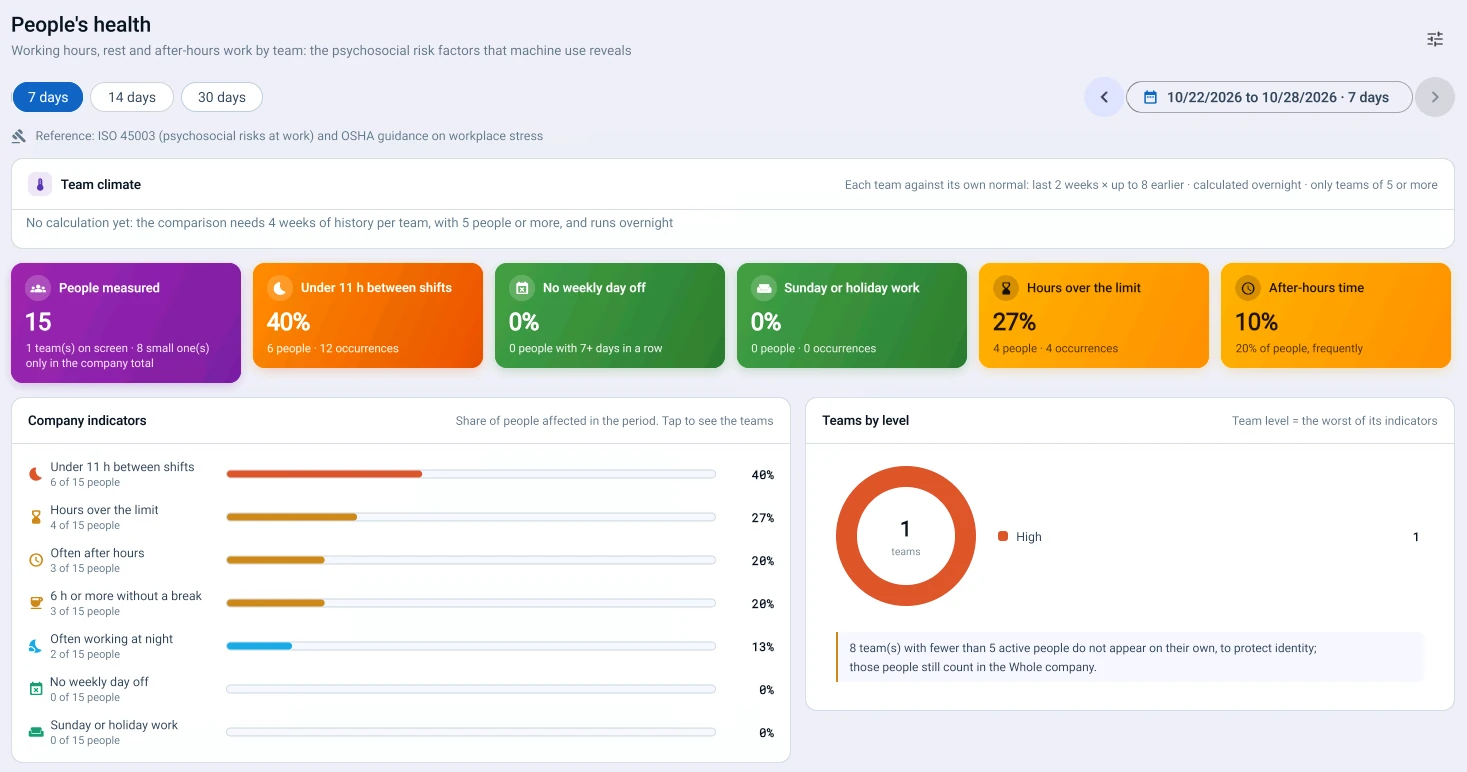
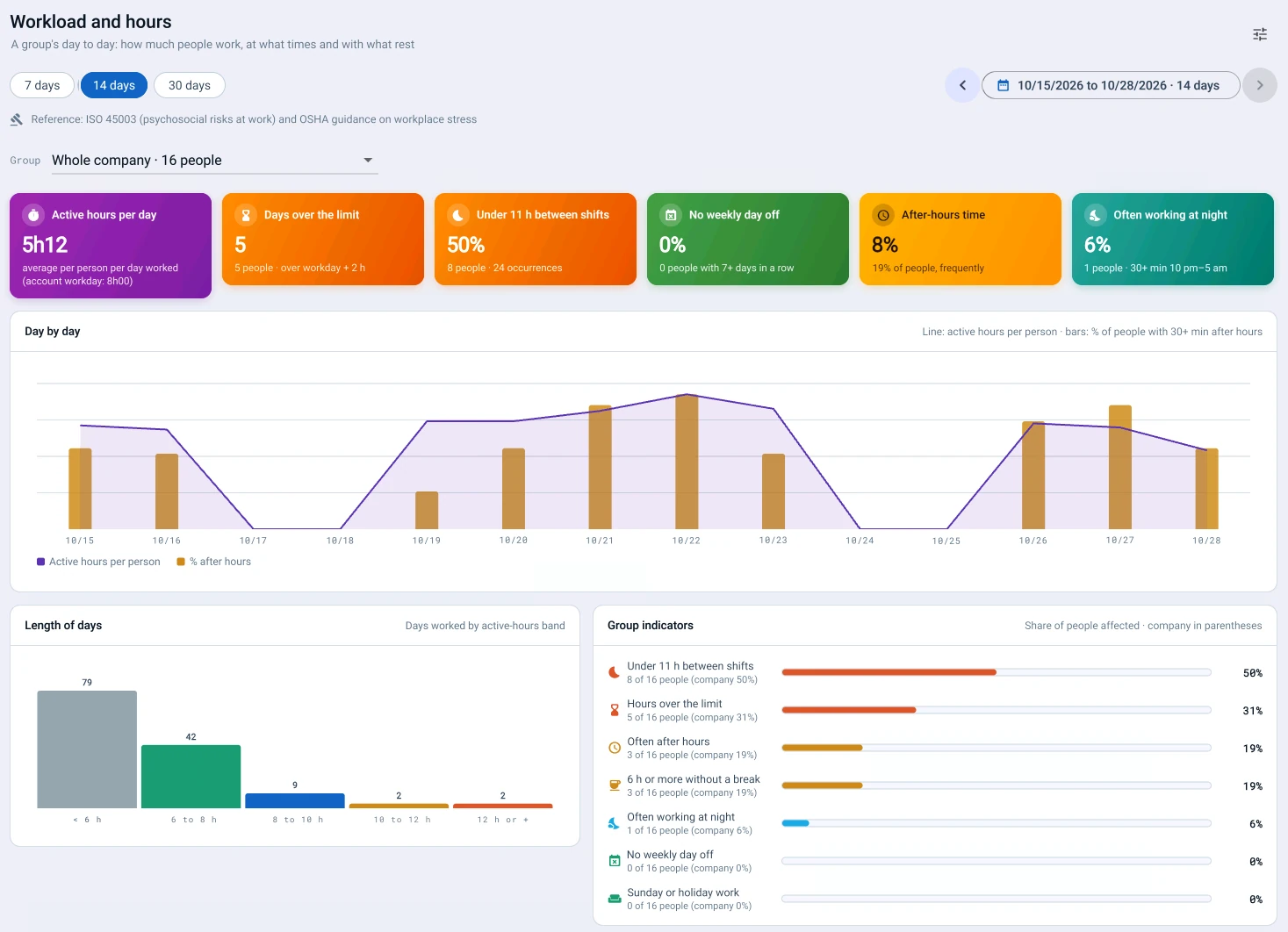
The indicators come from the machine-use time that Tz0 Metering already collects — People’s health is part of it —, read against common working-time and rest practice: 11 hours of rest between shifts, a weekly day off, breaks, overtime and night work. Results come out by team, only for groups of five people or more, and feed the risk assessment and action plan.
New indicator: affinity with other work. Professional profile notices when a person’s usage points to another activity and flags only the trend to HR, never the activity itself — a reason to talk about interests and development, not a conclusion. How it works →
Notice
Each person compared with themselves, not with colleagues.
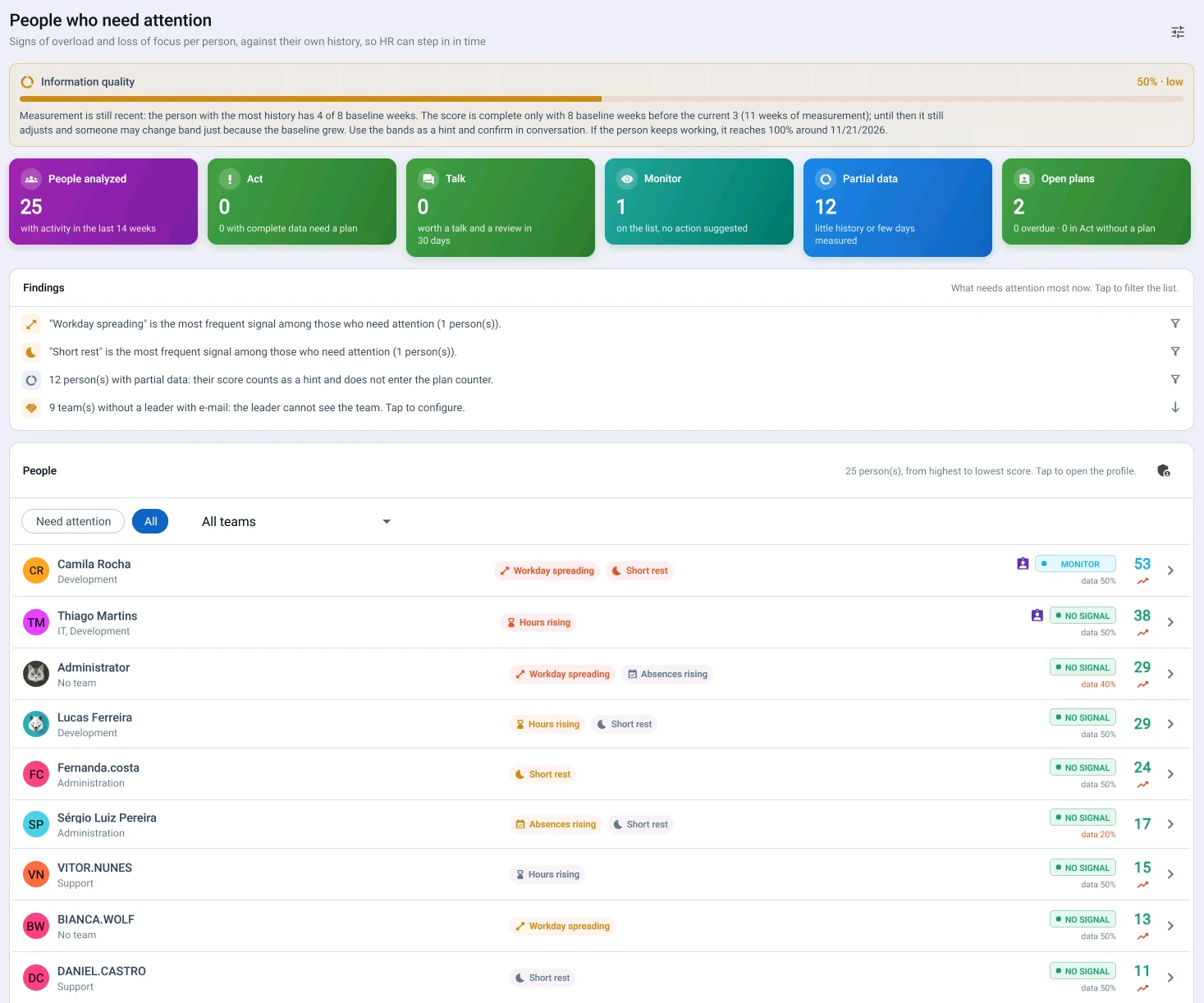
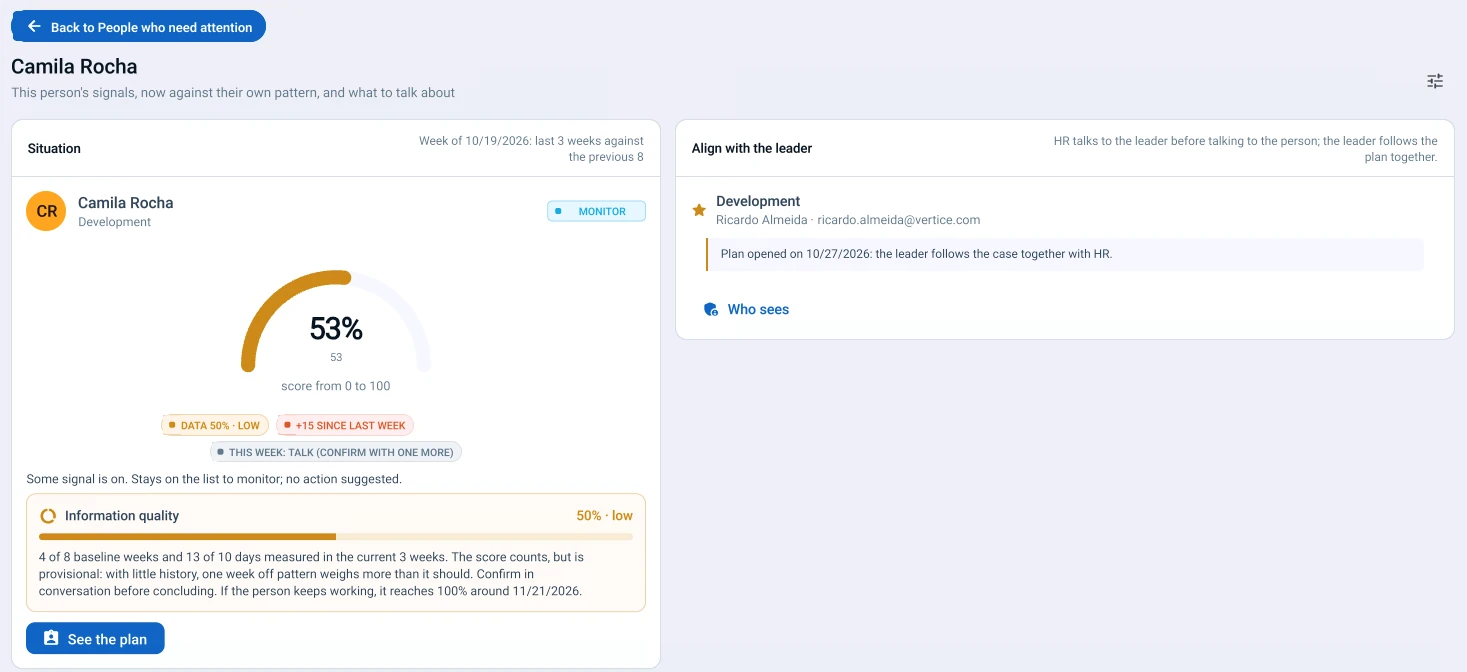
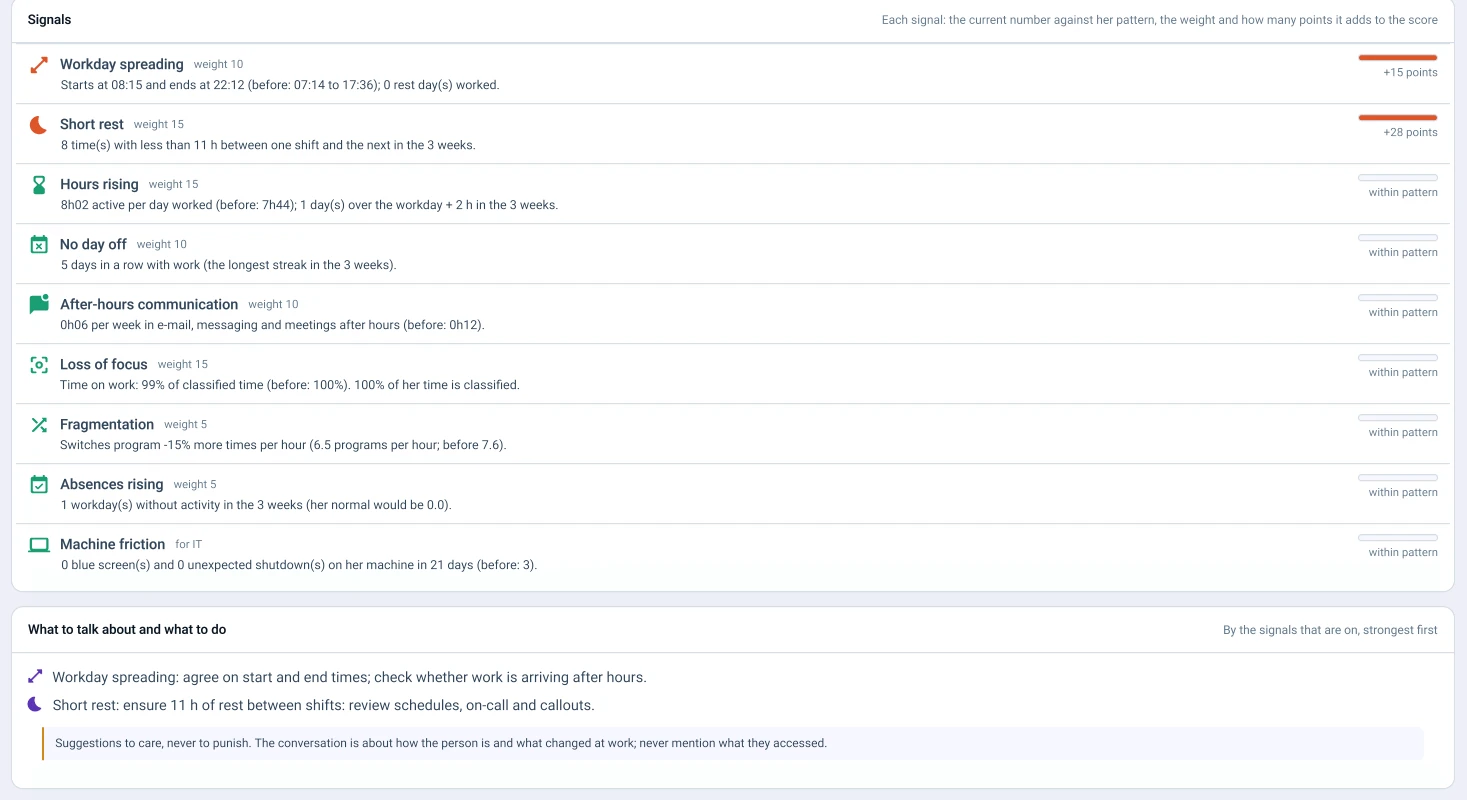
Someone who has always worked until 7 pm is not a signal. Someone who started working until 10 pm is. Trauma Zer0 compares each person’s last three weeks with the eight before across nine signals — workday spreading, short rest, hours rising, no day off, after-hours communication, loss of focus, fragmentation, absences rising and machine friction — and adds up a score from 0 to 100. The band only changes after two weeks in a row: one bad week does not trigger an alarm.
Care
From signal to care plan, with date, author and document.
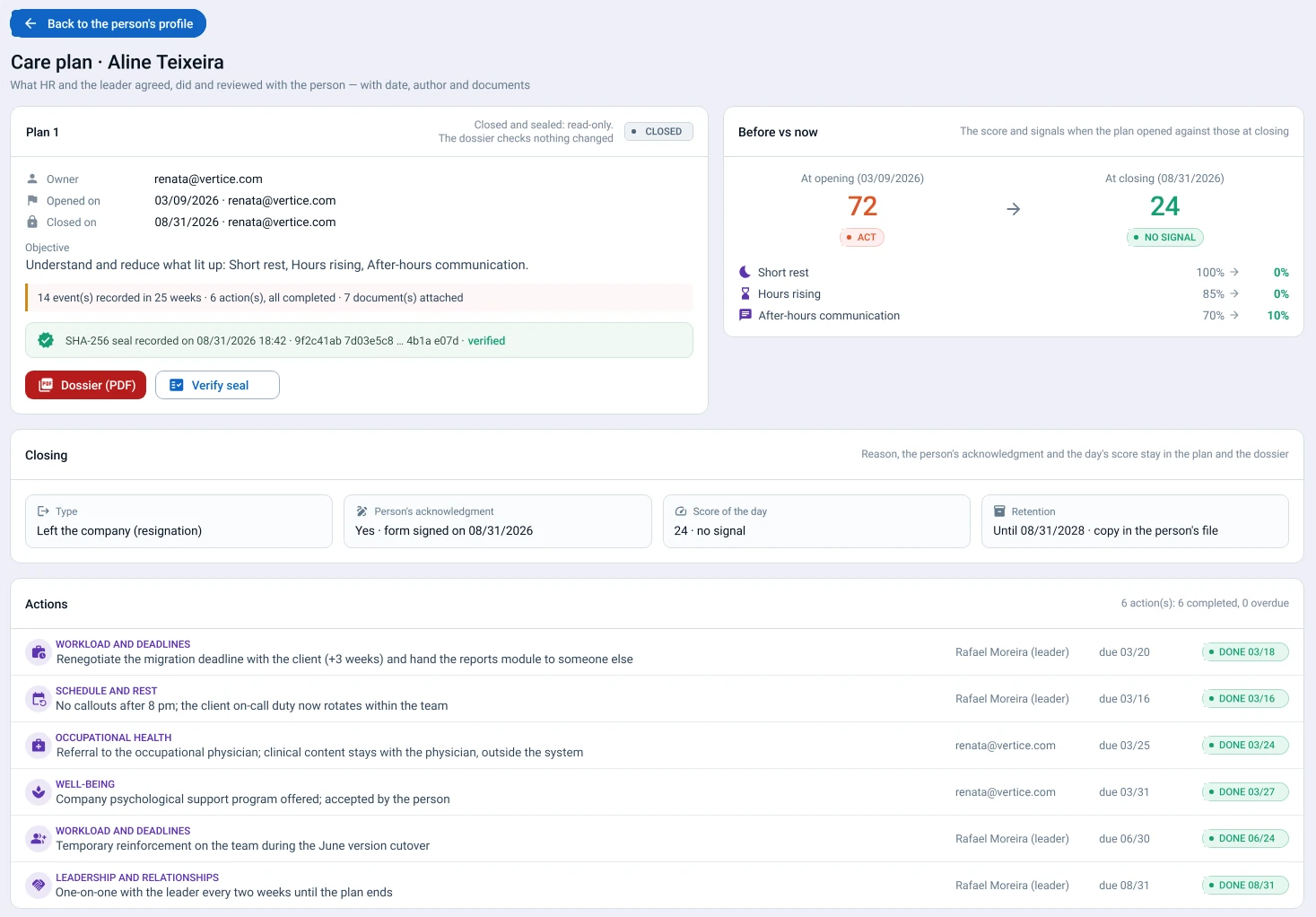
The plan follows the steps that hold up in a defense: opening with what lit up, alignment with the leader, listening to the person, actions with an owner and deadline — workload and deadlines, schedule and rest, well-being, environment, equipment, leadership and relationships, development, occupational health — and reviews with before and after. Nothing is deleted: to correct something, it is recorded again. Signed minutes, e-mails and receipts stay attached to the event they belong to. Clinical content stays with the physician, outside the system.
Prove
When the person leaves and files a claim, the company has something to show.
In a claim over work-related illness, what the company did to prevent it matters. When the plan closes, Trauma Zer0 computes a SHA-256 hash of every record and document and stores it once; from then on the plan is read-only. The PDF dossier includes identification, the reason, before and after, the actions, the timeline, the closing, who accessed it and the hash itself, with room for signatures — to print, keep in the employee’s file and hand to an expert if needed.
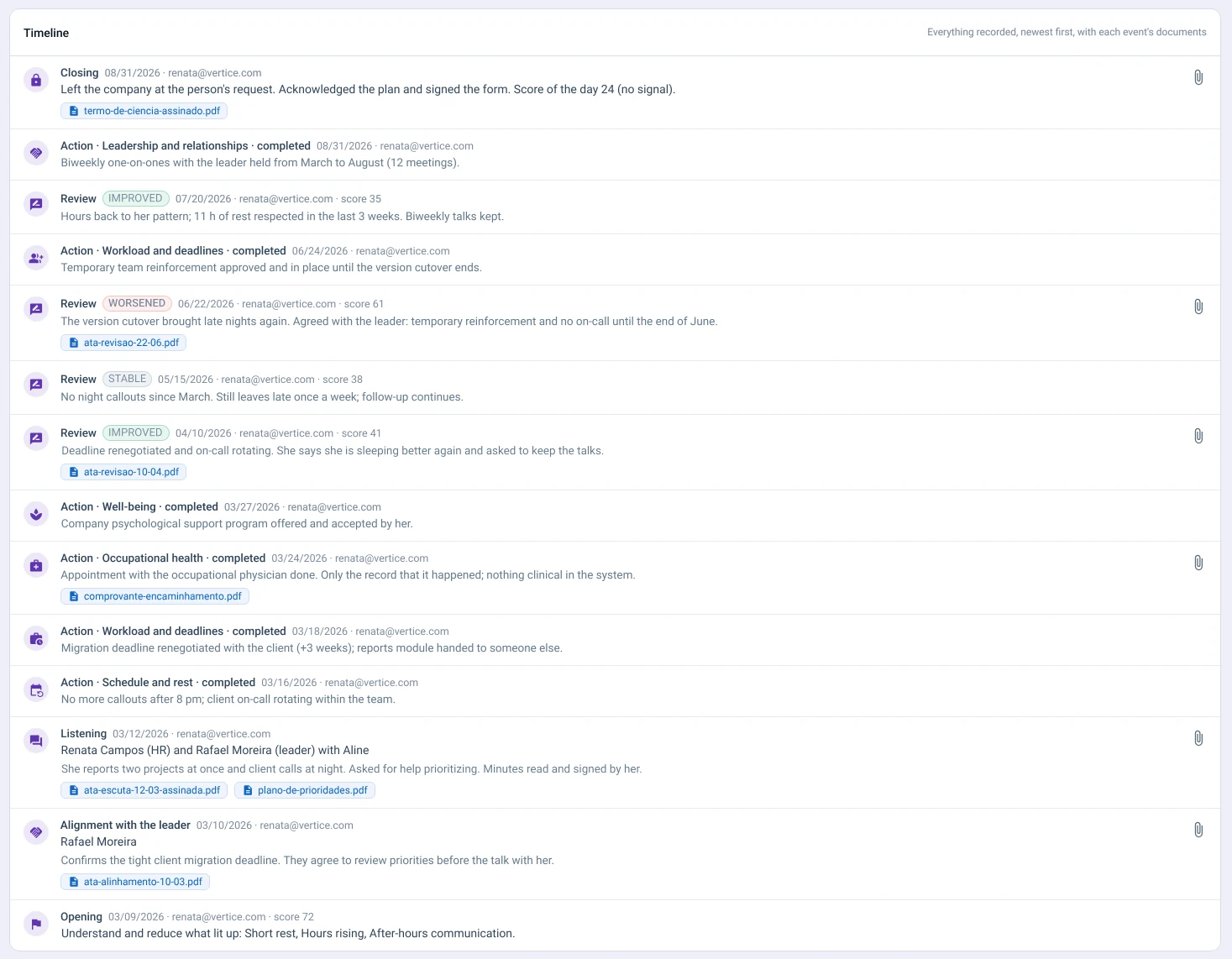
Screens from a real fleet in operation, with people’s names changed. The six-month plan is a demo case with fictitious data.
Who sees
People data is not machine data.
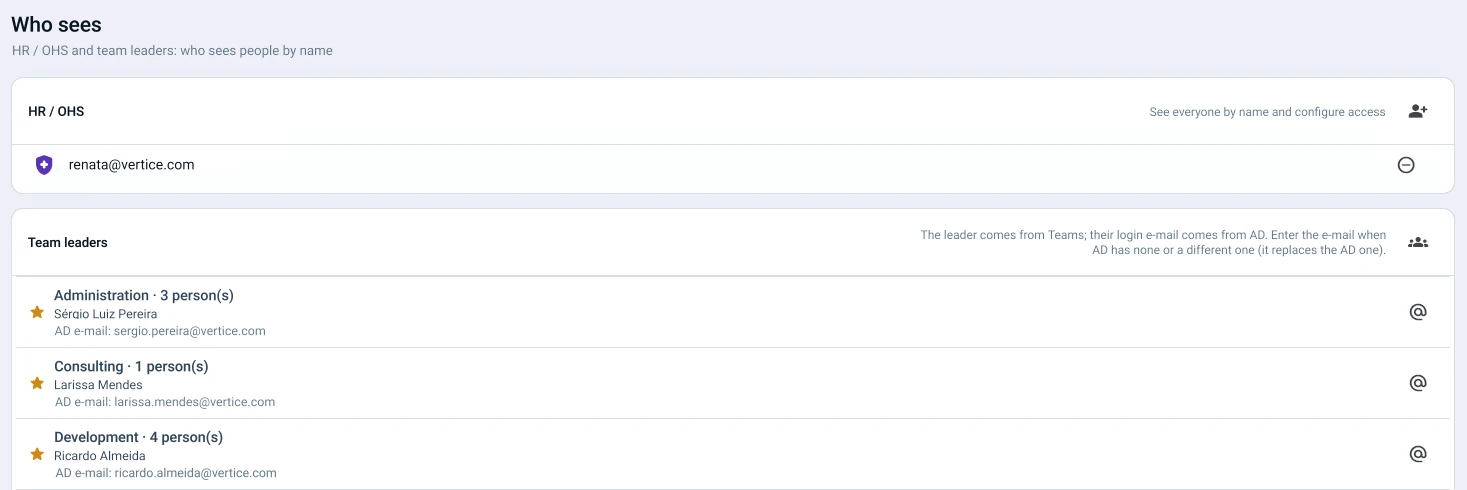
Information about someone’s working hours and behavior is delicate, and a sign of overload comes close to health data, which privacy laws treat as sensitive. That is why the module ships with the safeguards on.
Honest notice
It is not a diagnosis, not a time clock and does not replace listening to people.
The score is a technical hint so HR can offer care in time and document what it did. It does not identify burnout or any illness, it is not a performance review and it is not for punishing or firing anyone. It does not replace the psychosocial risk assessment done with workers, nor the occupational physician or safety professional. It is not a timekeeping system either: hours of work are still recorded the way the law requires.
And a caution that applies to any record: a signal noted and left unanswered weighs against the company. That is why the product counts who is in Act without a plan, and why it is worth agreeing with employment counsel on how the use will be communicated to employees.
Take this to your team
People's health · PDF · 758 KB
The brochure sums up this page in a PDF you can share with decision makers.
Download the PDFBring your risk assessment.
A 30-minute technical call: show us how the company assesses psychosocial risk today, and we will point out what the platform measures, what stays with HR and what stays with the assessment done with workers.