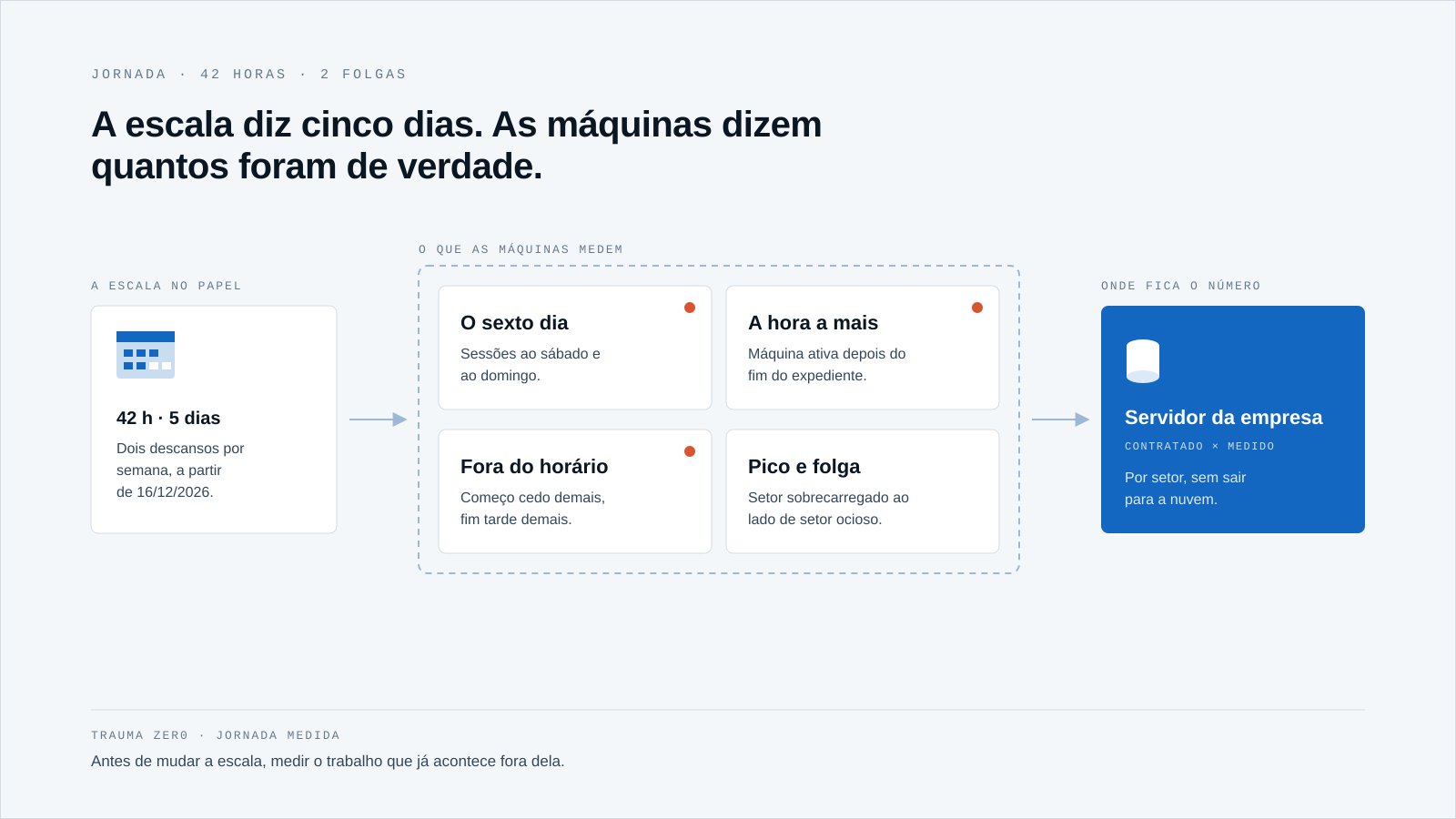
On December 16, the maximum working week in Brazil drops from 44 to 42 hours, with two paid rest days. A year later it drops to 40. The six-days-on, one-day-off schedule, known locally as 6×1, ends for most employment contracts.
HR is redrawing shift plans, legal is rereading collective agreements and finance is pricing the change. One question is missing, and none of those teams can answer it alone: how many hours do people actually work today?
The schedule says how many hours someone should work. The time clock says when they clocked in and out. The report finished on Saturday, the email answered at 10 p.m. and the spreadsheet closed from home show up in neither. That is exactly the part that decides whether a team fits into five days.
What changes, and when
Constitutional Amendment 141, enacted on October 16, 2026, replaces the 6×1 schedule with a five-day week without any pay cut. Two months after publication, the limit becomes 42 hours a week with two paid weekly rest days, one of them preferably on Sunday; fourteen months after publication, 40 hours. The rule also applies to existing contracts, according to the Brazilian Senate news agency.
The scale is large. According to a Labour Ministry survey cited by the Senate agency, about 14.9 million of the 44.7 million workers with an identified schedule are on 6×1 today, roughly one in three.
The transition rules are still moving. On November 12, Supreme Court justice Flávio Dino rejected employer confederations’ request to postpone the change, but allowed adjustments such as 8 hours 24 minutes a day in the first stage and 90 days from December 16 to renegotiate collective agreements. The case now goes to the full court, with no date set, as InfoMoney reported. The December 16 date still stands.
The schedule shows the plan. The machine shows the work.
Whoever redraws shifts usually starts from the contract: 44 hours, six days, so many people per shift. That number is what the company agreed, not what happens. With remote work, distributed teams and monthly targets, the gap can be wide, and it shows up in three places.
The sixth day that no longer shows on the clock
In many back-office areas, Saturday was abolished on paper long ago and survives in pieces: month-end close, order checks, customer replies. With two mandatory rest days, those pieces weigh more.
Tz0 Metering records how long each machine is used, hour by hour, and flags sessions outside business hours. Its heat map shows the hour when work starts outside business hours, weekends included. That is where you see which department still works the sixth day, before the new schedule turns into a liability.
The extra hour after leaving
Cutting two hours a week while keeping the same workload tends to push work past clocking-out time. The clock says 6 p.m.; the machine stays active until 7:30.
In Metering, the workday view puts payroll hours on one side and what the machine measured on the other: productive work, absence, arrival and departure outside the tolerance, and machines on with nobody at them. The gap between those two columns is the real size of the adjustment each team needs.
The team that does not fit in five days
Not every team is at the limit. Some have plenty of slack, others live at the peak. Applying the same rule to all of them leads to hiring where it is not needed and overloading where people were already short.
The module identifies idle periods and overload periods by department, which is the basis for redistributing work instead of hiring. With a number per team, the decision to open a position or change a shift has a measured reason behind it.
Readers of our piece on psychosocial risk and working hours will recognise the pattern: hours and rest are already recorded on the machines; someone just has to read them.
A new schedule fits on paper in an afternoon. Knowing whether it fits the team takes the number from before.
What measurement does not do
Measuring machine usage does not replace the legal time-keeping record. In Brazil, that record is still the one required by article 74 of the labour code. Measurement is there to compare what was agreed with what happens, not to punish anyone.
Every signal is a lead for a conversation, never a verdict. A long session after hours may be work, a machine left on or a video; the Metering index itself flags what can distort the measurement and asks the manager to check.
And working-hours data is personal data under the LGPD, Brazil’s data protection law. It is worth agreeing with labour counsel how the measurement will be explained to employees, just as you would before any usage measurement on the fleet.
How Trauma Zer0 helps
To go through the transition with numbers instead of assumptions:
- Work on the sixth day → sessions outside business hours and the Tz0 Metering heat map → the department that still works weekends shows up before December 16.
- The extra hour after leaving → payroll hours against measured hours, with arrival and departure outside the tolerance → the real size of each team’s adjustment.
- Teams at the limit and teams with slack → idle and overload periods by department → redistribute work before opening a position.
- A number that can be trusted → flags for machines left on and sessions with no break → the manager decides on a figure they know how to read.
All of this runs installed on your own infrastructure. Working-hours data stays on your server and does not go to anyone’s cloud, which matters when the subject is information about people.
Before December 16
The first stage starts in less than a month, the second, at 40 hours, in December 2027. Teams that measure now reach the first one with a picture of before, and the second one knowing what changed.
To see how Tz0 Metering shows your teams’ real working hours, request an evaluation and book a demo.