Since May 26, 2026, Brazil’s NR-1 — the regulation that governs occupational risk management — requires companies to include psychosocial risk factors in their risk management program (the PGR). The change came from Labor Ministry Ordinance 1,419/2024.
A month later, on June 25, Justice André Mendonça of Brazil’s Supreme Court (STF) suspended for 90 days the fines tied to those provisions, in case ADPF 1316. In September the suspension was extended for another 90 days. On October 13, the cases on the subject were paused for 60 days to allow negotiation, leaving the freeze on fines in place.
Many companies read this as a postponement of the obligation. It isn’t. In its own announcement of the decision, the STF stated that the general guidelines of the regulation remain valid and must be observed by employers.
What got more time was the fine. The risk inventory is still due — and much of what it asks for is already recorded on the company’s machines.
What the suspension covers, and what it doesn’t
The June decision deals with fines and other administrative sanctions. According to the STF, it covers the provisions on including psychosocial factors in risk management, choosing assessment tools, documenting criteria and analyzing whether measures work.
The regulation itself remains in force. In legal news site Migalhas’ coverage of the October 13 decision, labor inspectors can keep guiding and monitoring companies; they just cannot impose penalties while the injunction stands.
That leaves two things open: when fines come back, and in what wording. And one thing certain: when they do, the company will have to show what it identified, what it did and how it followed up.
Evidence of that kind cannot be produced after the fact. Either it was recorded at the time, or it doesn’t exist.
There is also another court that doesn’t wait for the STF. In a labor lawsuit over work-related illness, what the company did to prevent it carries weight, with or without a citation from the Labor Ministry.
The size of the problem the rule wants measured
Brazil granted 546,254 temporary disability benefits related to mental and behavioral disorders in 2025, up 15.66% from the previous year. The figures come from Brazil’s Social Security system and were presented at a seminar at the Federal University of Minas Gerais (UFMG), as the newspaper A Crítica reported in August 2026.
The figure doesn’t say how many of those cases started at work. It says the subject has left the HR slide deck and reached the social security budget — which is why the rule asks for a risk inventory, not a wellness campaign.
A psychosocial risk inventory isn’t an engagement survey either. It starts with how work is organized: how much people work, at what hours, with how much rest and under how much pressure.
Working hours and rest are risk factors that leave a trail
Some factors in how work is organized are hard to measure: role clarity, support from leadership, relationships within the team. Those call for conversation and questionnaires, and the assessment has to be done with the workers.
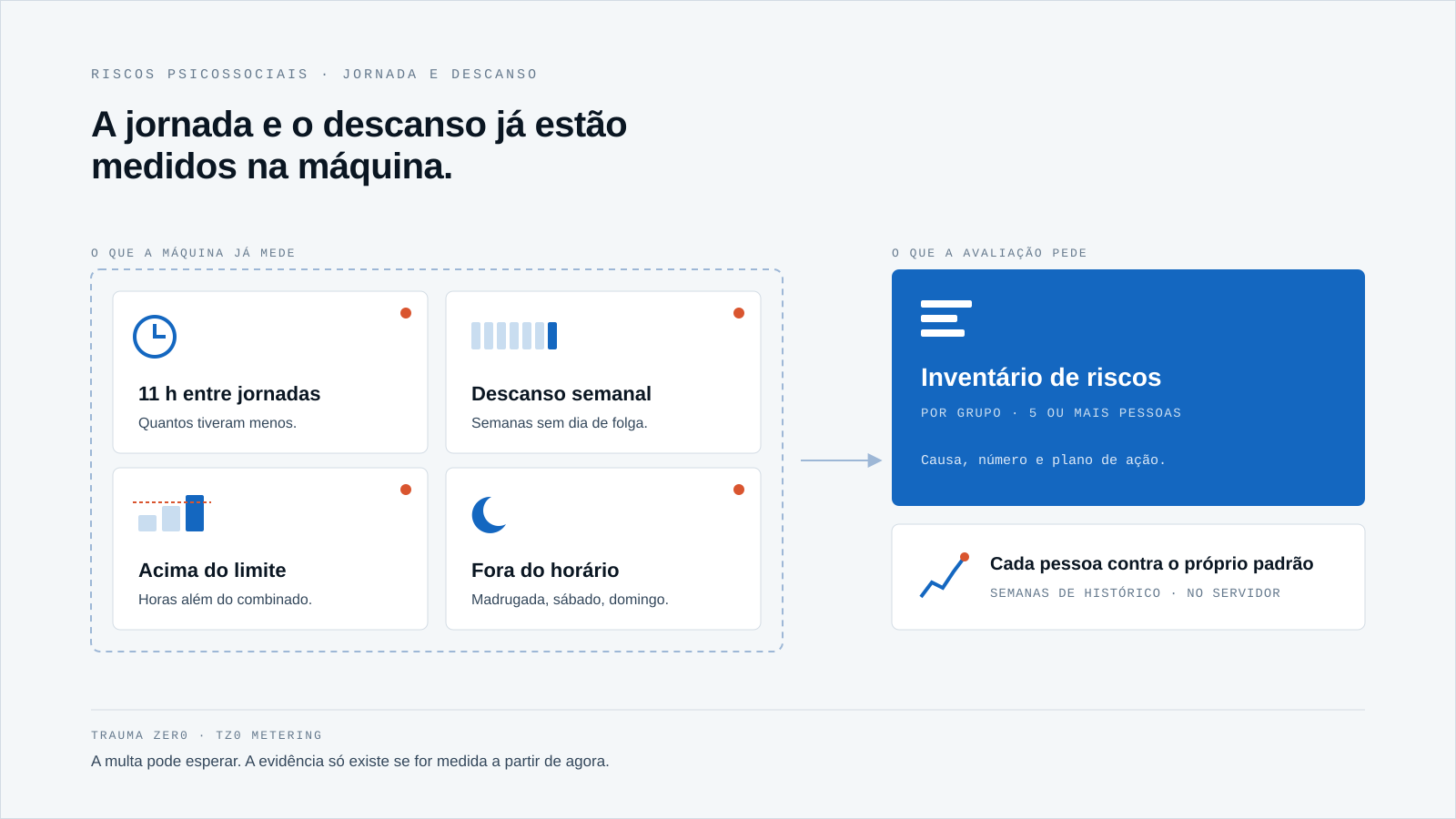
Others are recorded on every workstation, every day, without anyone having to ask:
- rest between one workday and the next, which Brazil’s labor code (CLT) sets at 11 hours (art. 66);
- the weekly day off (art. 67);
- hours beyond the overtime limit (art. 59);
- the break within the workday (art. 71) and night work (art. 73);
- the workday that starts earlier and earlier, or ends later and later.
The machine knows when it was used. If use starts at 7 a.m. and ends at 11 p.m., that is in the device’s record — not in the memory of whoever worked, nor in the manager’s impression. It’s the same count a software usage metering tool already makes for licenses and productivity.
For the inventory, what matters is the group: how many people on a team had less than 11 hours of rest during the week, which department went past the overtime limit, where Saturday became a workday. That kind of number turns “psychosocial risk” into a line in the risk program with a cause, a size and an action plan.
For people working from home, the reasoning is the same. A workstation outside the office also records when it was used, and the workday that stretches at home is often the one nobody sees.
Measure without surveilling, and don’t confuse it with timekeeping
Data about one person’s working hours is sensitive. A sign of overload comes close to health data, which Brazil’s data protection law (LGPD) treats as sensitive. A few safeguards separate useful measurement from surveillance:
- the indicator is reported by team, and small teams don’t appear on their own;
- what goes in is time and schedule, not content — no keystrokes, screens or messages;
- every access to individual data is logged, and who sees what is a server rule, not a screen rule.
Two caveats apply to any tool. Usage measurement is not timekeeping: the official record of working hours remains the one required by article 74 of the CLT. And a machine metric is not a diagnosis: no index identifies burnout or any illness.
Finally, a signal that is recorded and never answered counts against the company. Whoever measures needs a way to act on what was measured — and it is worth agreeing with employment counsel on how the measurement will be communicated to staff.
For the broader picture, our posts on explaining a workstation within three business days after a data incident and on the gap between installed and used software show the same principle: the answer is in the machine’s record.
How Trauma Zer0 handles it
In Trauma Zer0, the measurement comes from Tz0 Metering, which already records how long each machine is used. Its People’s Health component uses that time for NR-1, read against the CLT’s working-hours and rest rules: articles 59, 66, 67, 71 and 73.
Results are reported by team, only for groups of five people or more, and feed the risk inventory and the action plan of the PGR. For HR, each person is compared with their own pattern, not with colleagues, across nine signals and four bands: no signal, monitor, talk and act.
A signal leads to a care plan with an owner and a deadline, with minutes and documents attached to each step. When the plan is closed, a SHA-256 hash seals the records, and a PDF dossier shows what the company did.
HR and occupational health see everyone; a team leader sees only their own team. What goes in is time and schedule summed by hour, and everything stays on the company’s own server. The module does not replace the assessment done with workers, nor the occupational physician.
The deadline that matters is the evidence
The fine has an uncertain date. The trend the risk program needs to show does not: comparing a person with their own pattern takes weeks of history, and that history only exists if it is measured starting now.
Whoever starts measuring when sanctions return will reach the inspection with a snapshot of a few days.
Whoever starts today arrives with history, a plan and a review — and with answers to the three questions that matter: what the company identified, what it did and how it followed up.
If your psychosocial risk inventory still depends only on questionnaires, it’s worth seeing what your fleet already records. Request a Trauma Zer0 evaluation and check the working-hours and rest indicators in your own environment.